
What is GST?
GST (Goods and Service Tax) is a single indirect tax applied on the supply of goods and services in India. It replaced multiple taxes VAT, Service Tax, Excise Duty, etc.
GST was implemented in India on 1 July 2017.
GST is Charged at every stage of the supply chain, but the tax burden finally falls on the end consumer.
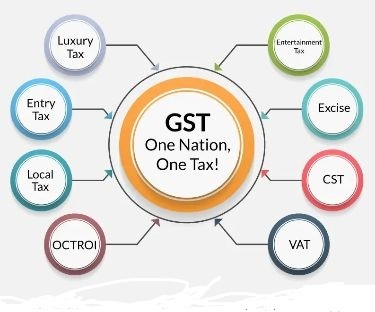
|GST One Nation One Tax diagram explaining replacement of VAT, CST, Excise, Octroi, and other indirect taxes.
Overall, GST has strengthened India’s tax structure more efficient for businesses and
All GST One Nation, One Tax | What is GST | GST Tax |
Why Was GST Introduced?
Before GST, business had to deal with:
Multiple indirect taxes
Different tax rules in every state
Tax on tax (cascading effect)
Benefits of GST ?
Goods and Services Tax (GST) has simplified India’s indirect tax systems by replacing multiple taxes such as VAT, Services Tax, and Excise Duty with a single unified tax. One of the biggest benefit of GST is the removal of the cascading. GST has made the tax Input Tax Credit (ITC) mechanism, which reduces the overall tax burden on consumers. GST has made the tax System more transparent and efficient by introducing online registration, return filling, and tax payment, which minimizes paperwork and human interference. It has also lowered the cost of doing business by creating uniform tax rate across states, making inter-state trade easier.
Small and medium business benefits from higher exemption limits and composition schemes, while improved logistics and faster movement of goods reduce transportation costs. Overall, GST supports business growth, improves compliance, and strengthens the India economy.
GST solved these problems by:
Unifying the tax systems
Making taxation transparent
Reducing tax burden
Improving ease of doing business
Types of GST Explained (Very Important)
- CGST (Central GST)
Collected by Central Government
Applied on intra-state sales
Examples :
Seller in Delhi sells goods to buyer in Delhi.
CGST + SGST
2. SGST (State GST)
Collected by State Government
Applied on intra-state sales
3. IGST (Integrated GST)
Collected by Central Government
Applied on inter-state sales
Example :
Seller in Delhi sells goods to buyer in Maharashtra
IGST Only
GST Tax Slabs in India 2025?
| GST RATE | Goods/Service |
| 0% | Essentials items Basic |
| 5% | Necessities |
| 12% | Standard goods |
| 18% | Most Services |
| 28% | Luxury items |
Who Should Register Under GST?
You must register for GST if:
Annual turnover exceeds:
40 Lakh (Goods)
20 Lakh (Services)
Inter-state seller
E-commerce seller
Service provider
Casual taxable person
Example of GST Calculation
Product price: 1,000
GST Rate: 18%
GST = 180
Final price = 1,180
if intra-state:
CGST = 90
SGST = 90
If inter-state
IGST = 180
What is Input Tax Credit (ITC)?
ITC means claiming the tax you already paid on purchases.
Example:
GST paid on purchase = 100
GST collected on sale = 200
GST payable = 200 – 100 = 100
This avoid double taxation.
Advantage of GST
- one nation, one tax
2. Easy online compliance
3. Transparent tax system
4. Boosts business growth
5. Reduces tax evasion
Q1. Is GST mandatory for small business?
Only if turnover exceeds the threshold or business falls under compulsory registration.
Q2. Is GST applicable to services?
Yes, GST applies to both goods and services
Q3. Can GST be filed without an accountant?
Yes, but professional help avoids errors and penalties.

One thought on “What Is GST? Meaning, Types, Benefits & Examples | Beginners Guide”
Comments are closed.